If you’re missing one or more teeth, you have more than one replacement option to consider. Implants, bridges, and dentures each work differently — here’s an honest comparison to help you understand the trade-offs before your consultation.
This is general information, and every patient’s situation is different. Please contact your dentist or our team for guidance specific to you.
The three main options, at a glance
| Dental Implant | Bridge | Denture | |
|---|---|---|---|
| How it’s held in place | Fused to the jawbone | Anchored to neighboring teeth | Removable, rests on the gums (or implant-supported) |
| Removable? | No | No | Usually yes |
| Affects neighboring teeth? | No | Yes — neighboring teeth are typically prepared to support it | No |
| Best for | Single or multiple missing teeth with sufficient jawbone | Missing teeth with healthy neighboring teeth | Missing several or all teeth in an arch |
How dental implants work
An implant replaces a missing tooth with a titanium post placed in the jawbone, topped with a custom crown. Because it’s fused to the bone, it functions much like a natural tooth and doesn’t rely on neighboring teeth for support. See our Dental Implants in Calgary guide for the full process.
How bridges work
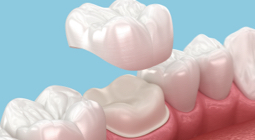
A bridge fills the gap left by a missing tooth using a false tooth anchored to the natural teeth on either side, which are typically shaped down to support crowns. Bridges don’t require surgery, but they do involve altering otherwise healthy neighboring teeth.
How dentures work
Dentures are removable replacement teeth, either partial (replacing some teeth) or full (replacing an entire arch). They rest on the gums, though implant-supported dentures — anchored by a small number of implants — are also an option for added stability.
Factors that typically guide the decision
A few things typically factor into which option makes sense:
- How many teeth are missing — a single missing tooth, several, or a full arch each point toward different options
- Jawbone health — implants require enough healthy bone to anchor into
- Condition of neighboring teeth — healthy neighboring teeth are needed to support a bridge
- Personal preference — some patients prefer a fixed, non-removable solution; others prioritize a lower-intervention approach
How to find out which is right for you
The only way to know which option fits your specific case is a consultation, where your dentist can examine your teeth and jawbone and walk you through the trade-offs honestly.
Explore the rest of this guide
Understanding implants:
- Dental Implants in Calgary: What They Are and How They Work
- Dental Implants vs. Bridges and Dentures (you’re here)
- Single-Tooth Implants vs. All-on-4
Deciding if it’s right for you:
Ready to talk it through? Book an appointment with Deerfoot Dental Centre in NE Calgary, or visit our Dental Implants page.
Frequently Asked Questions
Is a dental implant always better than a bridge or denture?
Not necessarily for every patient — each option has its place depending on jawbone health, the condition of neighboring teeth, and personal preference. Your dentist can help you weigh the trade-offs honestly.
Do bridges damage the neighboring teeth?
Neighboring teeth are shaped down to support the bridge, which is a permanent alteration — this is one of the key trade-offs compared to implants, which don’t affect neighboring teeth.
Can dentures be combined with implants?
Yes — implant-supported dentures use a small number of implants to anchor an otherwise removable denture, offering more stability than a denture alone.
Which option is most permanent?
Implants are the most permanent, fixed option since they’re anchored directly into the jawbone. Bridges are also fixed but rely on neighboring teeth. Dentures are typically removable.